Category: Actuality

  • Pharmia: the all-in-one platform for pharmacists

    Pharmia: the all-in-one platform for pharmacists

    Bill 67 is set to transform pharmacy practice in Quebec. Are you ready?

    A new reality for Quebec pharmacists

    The Quebec pharmacy landscape is undergoing a profound shift. With the adoption of Bill 67, pharmacists will see their scope of practice expand considerably: prescribing medication for common health conditions, diagnosed chronic diseases, prevention, specimen collection, and much more. Overnight, new professional acts will be added to an already demanding practice.

    These are major advances for access to care. But let’s be honest: more acts means more responsibility, more references to master, more documentation to produce — all in a labour-shortage context that isn’t improving.

    That is exactly why Pharmia exists.

    What is Pharmia?

    Pharmia is an AI-powered clinical platform, designed from the ground up for the reality of Quebec pharmacists. Not a translation of an American tool. Not a ChatGPT dressed up as a pharmacist. A complete ecosystem that covers the entire pharmaceutical consultation process: from patient history-taking to the generation of clinical documentation.

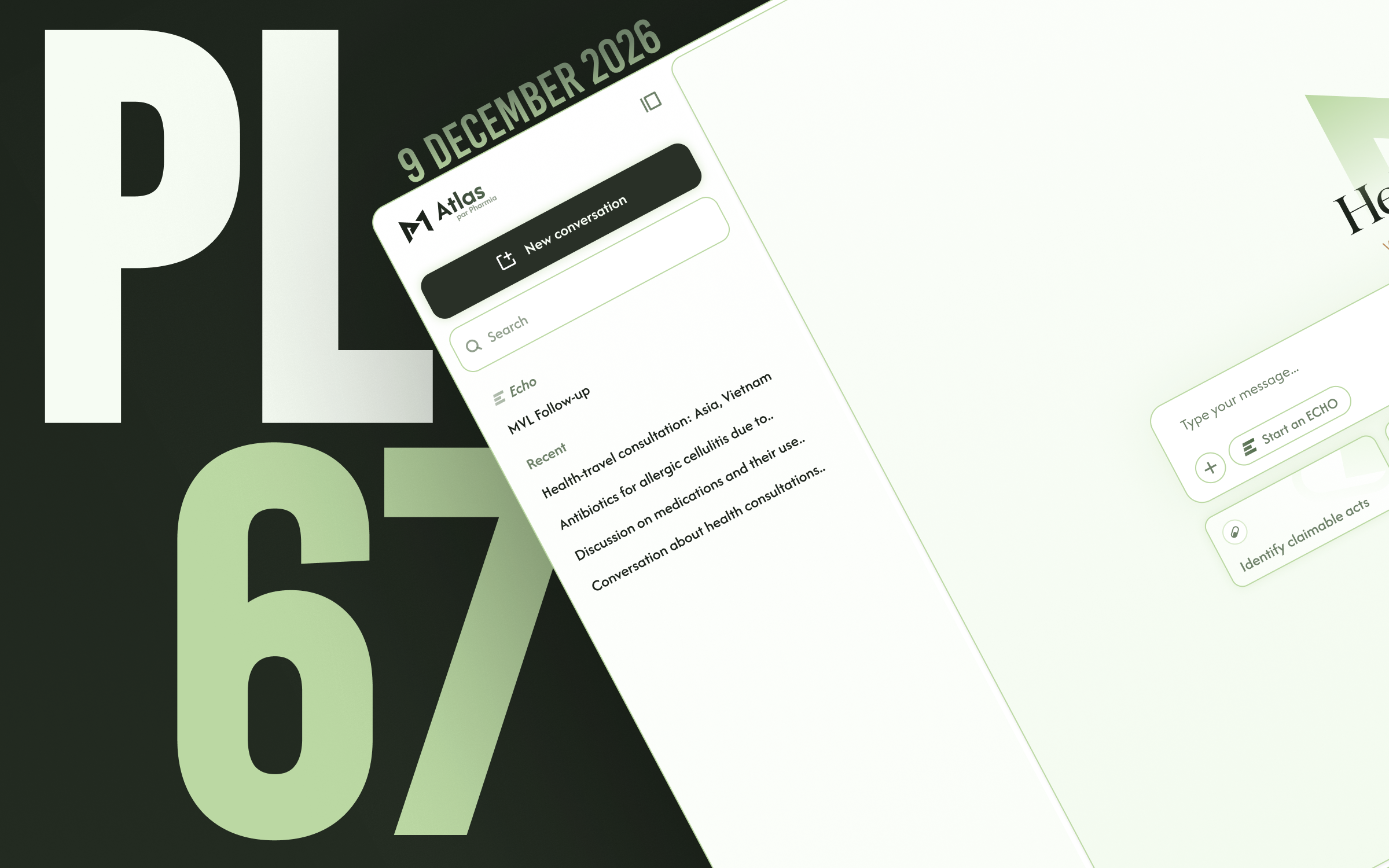
    The platform is built around three flagship tools: Pharmia Atlas, the clinical research copilot, Écho, the history-taking and clinical analysis assistant, and Pharmia Nexus, the optimized consultations module.

    Pharmia Atlas — your clinical copilot

    Pharmia Atlas is a clinical research assistant that understands the daily reality of the Quebec pharmacist. You ask a question in plain language. Atlas simultaneously queries recognized clinical databases and gives you a structured, sourced and actionable answer, all in a matter of seconds.

    Reliable sources, not hallucinations

    Every Atlas answer is grounded in verifiable clinical data. It doesn’t guess a dosage and doesn’t invent an interaction. Atlas queries directly:

    • Health Canada — official monographs, DIN, the Drug Product Database (DPD) and the Natural Health Products Database (NHPID)
    • PubMed — peer-reviewed scientific literature
    • FDA Drug Labels — American monographs and warnings
    • INESSS — Quebec clinical practice guidelines
    • PIQ and INSPQ — immunization protocols and public health recommendations
    • OPQ and APES — practice standards and professional references
    • Liverpool Drug Interactions — specialized drug interactions

    These are just a few examples — Atlas has access to many more clinical sources and databases, covering nearly all of a pharmacist’s information needs.

    Every source consulted is cited with a clickable link. No black box: clinical transparency.

    Built for the Quebec setting

    Atlas prioritizes Quebec references. When a pharmacist types “72 y.o. pt, CrCl 38, on metformin 1000 bid + glyburide 5 bid, HbA1c 8.2 — what to adjust?”, Atlas immediately flags glyburide as inappropriate in renal impairment per the RUSHGQ criteria, proposes a metformin dosage adjustment based on eGFR, and suggests a safe alternative antihyperglycemic — all with INESSS references and Quebec renal function thresholds.

    The tool understands mixed terminology (French-English) and the abbreviations pharmacists use every day (“bid”, “CrCl”, “tab”). It knows the billable acts under the AQPP-MSSS Agreement, collective prescriptions, the Pharmacy Act and the RAMQ billing codes.

    Dedicated modules for complex analyses

    Beyond one-off research, Atlas includes specialized modules for clinical tasks that require structured, in-depth analysis.

    Pharmacotherapy review. Atlas guides the pharmacist through a structured, exhaustive review of pharmacotherapy — interactions, safety, dosage adjustments, deprescribing and therapeutic gaps — all based on Quebec clinical references. A particularly relevant tool for the annual review of blister-pack patient files.

    Travel health consultations. Atlas has a dedicated travel consultation module, based on INSPQ, CDC and PIQ data. For each destination, it systematically assesses malaria risk (antimalarial chemoprophylaxis), traveller’s diarrhea (standby antibiotic and self-treatment), acute mountain sickness (acetazolamide prophylaxis when the itinerary warrants it) and the vaccines recommended per the PIQ. Atlas also identifies the associated billable acts — including assessments without a prescription, often under-billed in practice.

    More than 15 specialized tools

    Atlas does more than generate text. It uses real-time tools to:

    • Look up a drug by DIN, ATC code or brand name in the Health Canada database
    • Check drug shortages in Canada (Drug Shortages Canada)
    • Consult drug interactions across multiple databases
    • Generate immunization schedules based on the PIQ
    • Access CDC and INSPQ data for travel health consultations
    • Identify acts claimable to the RAMQ based on your clinical situation

    A personal workspace

    Beyond the chat, Atlas offers a document workspace. Pharmacists can upload their own documents — internal protocols, practice guides in PDF, reference tables — and Atlas integrates them into its research. A document shared once stays accessible across all future conversations.

    Écho — never miss a question, never miss a red flag

    Écho is the part of Pharmia that directly supports the consultation. When a patient presents with a health concern, Écho makes sure all the right questions are asked and that nothing slips through the cracks.

    Intelligent history-taking

    Pharmia’s history-taking agent talks directly with the patient, interactively, to gather the relevant clinical information. It clarifies, digs deeper and rephrases answers to maximize the quality of the data collected — all before the pharmacist even steps in.

    Red-flag detection

    Écho automatically identifies warning signs in the patient’s answers. A symptom that requires an urgent medical referral, a potential interaction with the patient’s medication profile, a contraindication — Écho detects them and highlights them for the pharmacist.

    Clinical analysis and prescription generation

    Once the history-taking is complete, Écho produces a structured summary of the consultation, identifies the clinical problems and proposes recommendations with or without a prescription. The pharmacist stays in full control: they validate, adjust and sign. Écho handles the paperwork.

    Automated documentation

    The reality in pharmacy is that writing a complete SOAP note while keeping up the pace is demanding. With Écho, documentation is generated automatically — SOAP notes, DAP, or custom formats — according to the pharmacist’s choices. All they have to do is validate.

    Pharmia Nexus — optimized consultations

    Nexus automates information gathering before the consultation: the patient answers questions online, and the AI structures the clinical data for the pharmacist. Automatic detection of applicable clinical algorithms, regulatory verification, identification of billable acts and generation of documentation. The pharmacist receives a pre-analyzed file and focuses on their clinical judgment.

    Why now? Bill 67 changes everything

    Bill 67, adopted in November 2024, represents the largest expansion of pharmacists’ scope of practice in a generation. Prescribing medication for common health conditions, diagnosed chronic diseases, prevention, diagnostic tests, specimen collection — the list is long and the responsibilities are real.

    The challenge is that these new acts come with a host of new references, new clinical algorithms and new documentation requirements. A pharmacist who starts prescribing for hypertension, diabetes or migraine must master the corresponding INESSS guidelines, know the critical values, and document their six-step prescribing process — all on top of an existing workload.

    This is where Pharmia makes the difference. Atlas puts all those references at your fingertips, instantly. Écho structures the consultation so nothing is forgotten. Documentation is generated automatically. The pharmacist can focus on what truly matters: their clinical judgment and the patient in front of them.

    The shortage in the background

    Quebec is experiencing a pharmacist shortage that puts pressure on the entire network. Every minute counts. The time a pharmacist spends hunting for an interaction across three different tabs, cross-referencing sources by hand or writing a clinical note is time not invested with patients.

    With Pharmia, a search that used to take 10 to 15 minutes now takes a few seconds. Documentation that took 5 minutes is generated automatically. Multiplied by the number of consultations in a day, that’s a concrete time saving that eases the workload — and helps make the profession more sustainable.

    “Pharmia Atlas is a real asset! I no longer have to lose several minutes on my research. I can ask all my questions and it answers me with reliable references.”

    Accessible to all, adapted to each

    Pharmia is an all-in-one platform for pharmacy: history-taking, clinical analysis, research, documentation, billing. But an individual pharmacist doesn’t need to adopt the whole thing to benefit from it.

    Pharmia Atlas and Écho are available individually. A pharmacist in a community pharmacy, a FMG, a healthcare institution or even solo practice can use Atlas as a daily clinical copilot, or Écho to structure their consultations — without having to integrate the entire platform into their workplace.

    Security at the core of everything

    In pharmacy, data security is non-negotiable. Pharmia was built with compliance in mind:

    • Hosted in Quebec — data stays in Quebec and never crosses the border
    • Law 25 and PIPEDA compliance — full compliance with Quebec and Canadian personal-information protection laws
    • Certifications in progress — SOC 2 and TGV in the process of being obtained
    • No data used for training — conversations, documents and patient data are never used to train AI models
    • End-to-end encryption — data is transmitted and stored securely
    • Complete logging — traceability audits are available at all times

    The future of pharmacy practice starts today

    Artificial intelligence is already transforming many sectors. With Bill 67 coming and the shortage persisting, Quebec pharmacists need tools that increase their clinical capacity without increasing their workload.

    Pharmia is the bridge between the pharmacist’s clinical expertise and the power of AI — instant access to pharmaceutical knowledge, a structured consultation that leaves nothing to chance, and documentation that takes care of itself. All designed by a team that understands the daily reality of Quebec pharmacy.

    Discover Pharmia and see how AI can become your best clinical ally.

    Test pharmia here !

  • When Administration Stifles Clinical Care: The Real Cost of Bureaucratic Burden in Pharmacy

    When Administration Stifles Clinical Care: The Real Cost of Bureaucratic Burden in Pharmacy

    Quebec pharmacists lose hundreds of hours every year to administrative tasks. Meanwhile, patients wait — and the healthcare system runs out of breath.

    A clinical activity in full expansion

    In 2023, Quebec’s community pharmacies delivered more than 7 million clinical acts — a 16% increase in a single year. Since 2019, that’s a 51% growth in clinical activity. Quebec pharmacists have become, de facto, the first point of contact in the healthcare network: accessible without an appointment, seven days a week, in more than 1,900 pharmacies across the province.

    But this clinical growth has happened without the resources to support it.

    The shortage that amplifies everything

    Quebec is short roughly 1,150 pharmacists. The vacancy rate in community pharmacy reaches 12%, four times the provincial average across all sectors. In 2024, one million replacement hours were needed just to maintain basic service.

    And a significant share of those hours never even reaches the patient.

    The daily reality behind the counter

    The typical day of a community pharmacist in 2026 isn’t only clinical work. It’s also:

    • Answering calls from other pharmacies and physicians to clarify prescriptions, confirm therapies, or coordinate file transfers.
    • Documenting every clinical intervention in often outdated systems, then faxing — yes, faxing, in 2026 — follow-ups to prescribers.
    • Verifying, before each act, whether it complies with the regulatory framework in force: laws, regulations, agreements, exceptions.
    • Filling out administrative forms that have no clinical value but are required by the system.
    • Calling patients back for follow-ups the system doesn’t handle automatically.

    These tasks are necessary in principle, but their execution remains largely manual, fragmented, and time-consuming.

    The numbers tell the story

    In Quebec

    According to the 2024 survey of its members by the APPSQ (Quebec’s professional association of salaried pharmacists), most salaried pharmacists report a workload that is still far too heavy and conditions that are poorly suited to clinical practice. Even more revealing: 65% of respondents fear that the new acts introduced by Bill 67 will worsen this overload if no concrete administrative relief accompanies the expanded scope of practice.

    The AQPP (Quebec association of pharmacy owners) sounded the alarm as early as March 2024, publicly calling for the removal of certain administrative rules surrounding clinical activities. The message was clear: rules designed to frame practice end up restricting patients’ access to care. AQPP president Benoit Morin summed it up this way: the barriers must come down so that the 7,000 pharmacists in the network can serve their patients effectively.

    Across Canada

    The Quebec picture fits within a documented national trend. The Canadian Medical Association (CMA) estimates that Canadian healthcare professionals collectively lose 18.5 million hours per year on unnecessary administrative tasks — the equivalent of 55.6 million patient visits. And according to the CMA, 85% of that work comes from the healthcare system’s own processes, not from the clinical complexity of the cases.

    For pharmacists specifically, data from the Canadian Pharmacists Association (CPhA) reveals a direct link between administrative burden and burnout: pharmacists experiencing burnout spend an average of 7.5 hours per week on administrative tasks, compared to 4.3 hours for those who aren’t. In 2023, 79% of pharmacy professionals in Canada were at risk of burnout.

    Internationally

    The phenomenon isn’t unique to Canada. In the United States, recent studies report that pharmacists can spend up to 90% of their time on administrative tasks rather than direct patient care. Pharmacy staff burnout has reached historic levels there, largely attributed to workload and chronic understaffing.

    Bill 67: a major step forward, but incomplete

    Adopted by the National Assembly, Bill 67 represents a historic reform of Quebec’s pharmacy legal framework. It promises to substantially expand pharmacists’ professional autonomy:

    • Prescribing medication with fewer restrictions
    • Extending prescriptions without arbitrary deadlines
    • Substituting medications in more clinical situations
    • Replacing certain administrative rules with the pharmacist’s professional judgment

    The Ordre des pharmaciens du Québec (OPQ) hailed the reform as “a historic step for access to care.” The draft regulation was published in the Gazette officielle in June 2025 for public consultation, with updates in October 2025.

    But adopting the law doesn’t solve everything. The APPSQ underlined this in its November 2025 statement: current working conditions in community pharmacy still cannot absorb the new responsibilities introduced by Bill 67. Without concrete relief from the administrative burden, expanding the scope of practice amounts to adding more weight onto already overloaded shoulders.

    La Presse reported in December 2025 that the expansion of pharmacists’ powers was slow to materialize in practice, despite the law’s adoption.

    The real problem: systems built for another era

    The administrative burden in pharmacy is no accident. It’s the result of systems designed decades ago, when the pharmacist’s role was essentially limited to dispensing medication. These systems — pharmacy software, prescriber communication processes, billing mechanisms, documentation protocols — haven’t evolved at the same pace as the practice.

    The result is a structural mismatch:

    • Fragmented inter-professional communication: fax remains the dominant communication mode between pharmacies and prescribers in most practice settings.
    • Redundant documentation: a single clinical act can require documentation in the pharmacy software, a paper form, a fax to the prescriber, and a chart note.
    • Manual regulatory verification: before each expanded act, the pharmacist must mentally (or physically) review the applicable regulatory framework — laws, regulations, AQPP-MSSS agreements, collective prescriptions — to confirm the act is permitted.
    • Complex billing: the billing system for clinical acts, governed by the AQPP-MSSS agreement, includes dozens of codes, conditions, and exceptions that vary by act type, patient status, and clinical situation.

    What technology can change — and what it can’t

    Technological solutions exist, and some are already deployed in other jurisdictions or other healthcare sectors. Among the most promising avenues:

    Automated clinical documentation

    Artificial intelligence can now capture, structure, and write clinical documentation from a conversation between the professional and the patient. Platforms like Abridge (which reached $100M in annual revenue automatically documenting medical consultations) show that the technology is mature. The same principles apply in pharmacy: capture the clinical exchange, generate the note, the follow-up, and the prescriber communications — automatically.

    Intelligent regulatory verification

    Instead of forcing the pharmacist to manually consult the legal framework before each act, a smart tool can cross-reference the clinical situation with the current regulations and confirm compliance instantly. That’s the “compliance by design” approach: the system checks for you, in real time.

    Information system integration

    Communication between pharmacies, prescribers, and healthcare facilities should be digital, bidirectional, and instant. The Dossier Santé Québec (DSQ) is a step in that direction, but its integration into daily workflows remains incomplete.

    Billing automation

    Billing for clinical acts can be automatically derived from the documented act, eliminating double entry and coding errors.

    What technology doesn’t replace

    The pharmacist’s clinical judgment. The trust relationship with the patient. The assessment of a complex situation that requires experience and context. Technology isn’t there to replace the pharmacist — it’s there to give back the time to do what they were trained for.

    The real issue: time

    Every hour spent filling out a form, faxing a document, or manually checking a regulatory framework is one less hour at the counter with a patient. In a labour shortage context, every hour counts.

    The question isn’t whether pharmacists can do more. They are already doing more, every year, with fewer people. The question is how much longer we keep wasting time on processes that could be automated — and how many patients miss out on care that could have been provided if the pharmacist had had five more minutes.

    Bill 67 gives pharmacists new powers. It’s time to give them the tools to exercise them.


    Pharmia builds artificial intelligence tools designed specifically for Quebec pharmacists — automated clinical documentation, real-time regulatory verification, and instant access to the entire normative framework of pharmacy practice in Quebec.


    References

    1. AQPP — “Pharmacy owners call for the removal of certain administrative rules” (March 2024)
      monpharmacien.ca
    2. La Presse — “Pharmacy owners call for the removal of certain administrative rules” (March 2024)
      lapresse.ca
    3. APPSQ — 2024 survey on irritants in community pharmacy
      appsq.org
    4. APPSQ — Statement on Bill 67 (November 2025)
      appsq.org
    5. Canadian Medical Association (CMA) — Administrative burden: facts and figures
      cma.ca
    6. Canadian Pharmacists Association (CPhA) — National survey on the mental health of pharmacy professionals (2023)
      pharmacists.ca
    7. Ordre des pharmaciens du Québec (OPQ) — “Bill 67 adopted: a historic step for access to care”
      opq.org
    8. OPQ — “Bill 67 adopted: fewer administrative barriers, more autonomy”
      opq.org
    9. La Presse — “Expansion of pharmacists’ powers slow to be implemented” (December 2025)
      lapresse.ca
    10. OPQ — Bill 67 draft regulation, Gazette officielle (June 2025)
      opq.org
    11. Profession Santé — “Pharmacy irritants: APPSQ unveils its survey” (August 2024)
      professionsante.ca
    12. Portail de l’assurance — “Pharmacists play a growing role in primary care” (April 2026)
      portail-assurance.ca
    13. Sully.ai — “Top 3 AI Pharmacists in 2026”
      sully.ai
    14. MedMe Health — “An Overview of AI in Pharmacy” (2025)
      medmehealth.com
    15. Contrary Research — “Abridge Business Breakdown”
      research.contrary.com
  • Your Pharmacy Could Soon Close Its Doors. Here Is Why.

    Your Pharmacy Could Soon Close Its Doors. Here Is Why.

    A message from your pharmacists to the people of Quebec because your access to healthcare concerns all of us.


    What the government is doing, and why it directly concerns you

    Right now, in Quebec City, an amendment to Bill 15 is about to change the life of every Quebecer who sets foot in a pharmacy, that is, practically everyone.

    The government is about to cap the fees that pharmacists can charge private insurers. In other words: they want to force pharmacies to operate on revenues that do not even cover their actual costs.

    This is not an abstract debate between politicians and lobbyists. It is your neighbourhood pharmacy that is threatened. It is your access to healthcare that is at stake.

    What will change in your daily life, concretely

    Your pharmacy will close earlier

    Are you used to stopping by the pharmacy on Saturday afternoon, or in the evening after work? If this amendment passes, many pharmacies will no longer be able to afford staying open outside peak hours. Evenings, weekends, holidays, the time slots when you need them the most will be the first to go.

    You will wait longer at the emergency room

    In recent years, with Bills 31 and 41, your pharmacist can prescribe an antibiotic for a urinary tract infection, treat your conjunctivitis, vaccinate you, and adjust your medications. Quick, accessible care, no appointment needed. If pharmacies can no longer afford to offer these services, those patients go back to the ER. The ER that is already overflowing. The ER where you wait 12, 14, 18 hours.

    Your neighbourhood pharmacist will disappear

    There are 1,900 community pharmacies in Quebec. Some are the only source of healthcare in their village. If we cut the revenues of these pharmacies, it is the regions that suffer first. Not Montreal. Not Quebec City. The small villages where your grandmother picks up her heart medication, where the pharmacist is the only healthcare professional within a 45-minute drive.

    Your employer will cut your insurance coverage

    If the government caps what pharmacists can charge private insurers, the insurers will adjust their grids, but not necessarily in your favour. The domino effect is predictable: group insurance plans will be renegotiated, deductibles increased, coverage reduced. You will pay more out of pocket for the same medications.

    Your pharmacist will have less time to talk to you

    The salaried pharmacist who takes five minutes to explain the side effects of your new medication. The pharmacist who calls your doctor to flag a dangerous interaction. The family pharmacist who has known your file by heart for ten years. All of that takes time and resources.

    The real winners: insurers and multinationals, not you

    They want you to believe this measure is in your interest. Yet it is not your pharmacist’s fees that are driving up your insurance premiums. It is the rising costs of specialty medications, treatments that cost tens of thousands of dollars a year and are manufactured by multinational pharmaceutical companies.

    Your premiums are going up? It is because of these overpriced medications, not because of the pharmacist who serves you at the counter. The AQPP says it clearly: the real debate should be about the rising cost of medications, not about the revenues of neighbourhood pharmacies.

    By going after pharmacies rather than the true sources of pressure on the system, the government is protecting the interests of private insurers and pharmaceutical giants, and you are the one paying the price.

    The paradox that should outrage everyone

    The government expanded the role of pharmacists with Bill 67, a law that told them: “You are capable of doing more. Prescribe, draw blood, vaccinate, treat.” Pharmacists accepted. They trained. They invested.

    And now, the same government is about to cut their revenues. Concretely, it is telling them: “Figure it out.”

    It is like asking a contractor to renovate an entire building, then telling them you will only pay half the bill, after the work has already started.

    The financial impact the government does not want you to see

    The amendment represents an approximately 25% decrease in revenues for community pharmacies.

    A quarter of revenues. Gone. Overnight.

    • 25% less revenue means 25% less investment: fewer staff, less training, fewer technologies, fewer clinical services for you.
    • This revenue gap does not come from “greedy” pharmacists. It comes from the fact that public plan rates have not been properly indexed for over 20 years. Meanwhile, everything has gone up: rent, salaries, insurance, software, training.
    • Instead of correcting the chronic underfunding of the public plan, the government is choosing to level down.
    • For a typical pharmacy, this revenue loss is equivalent to having to cut positions, reduce opening hours, and abandon the very services that Bill 67 asks them to provide.

    Who is behind this measure?

    The amendment was proposed by Québec solidaire MNA Alexandre Leduc, adopted without consulting pharmacists, without notice, and in the middle of negotiations between the AQPP and the government.

    The AQPP withdrew from the negotiating table, an unprecedented move. Its president, Benoit Morin, called the amendment a “massive slap in the face.”

    The cases of “overbilling” that fuelled the media debate involve a handful of players in specialty medications. The AQPP had proposed targeted solutions to address these abuses. The government ignored them and chose to punish all 1,900 pharmacies in Quebec.

    The industry is unanimous: this is unacceptable

    The entire profession, owners, employees, independents, technicians is on the same side. The professional orders, the associations, the banners: no one supports this amendment. Because everyone knows that if pharmacies fall, it is the patients who pay the price.

    It is an entire profession sounding the alarm to protect your access to healthcare.

    What the government should do instead

    The solution is simple: instead of cutting pharmacy revenues, the government must increase RAMQ rates to reflect the real cost of pharmaceutical services in 2026, and tackle the true causes of rising premiums the costs of specialty medications and the practices of major insurers.

    You do not fix an underfunded system by impoverishing those who hold it together.

    What you can do

    Share this article. Show it to your family, your colleagues, your neighbours. The more people understand what is happening, the more pressure the government will face to back down.

    Write to your MNA. It is simple and takes two minutes. Go to jappuiemonpharmacien.com to send a letter directly to your elected representative.

    Ask them:

    • “Do you find it acceptable that I would have to wait 18 hours in the ER for a urinary tract infection that my pharmacist could have treated in 20 minutes?”
    • “Is it acceptable that I lose the care provided by my family pharmacist for my chronic pain that has lasted for years?”
    • “Who will adjust my mother’s diabetes medications if her neighbourhood pharmacy closes?”
    • “My pharmacy is open until 9 PM, it is the only place I can go after work, do you find it acceptable that it closes at 5 PM?”

    Because that is exactly what is coming if no one reacts.


    References